Internal Presentation of Project Results (Drafts)
Scientific collaborations are one of the key forms of interaction among researchers through which new scientific knowledge is created and disseminated. The basic research project Mentorship in the Context of Scientific Collaboration and Knowledge Production examines relationships between mentors and mentees, which represent a specific form of scientific collaboration within higher education. The project primarily explored how mentoring relationships at the doctoral level contribute to the production and transfer of knowledge. The findings are important not only for mentors, who are key actors in doctoral education, but also for policymakers and institutions in the fields of higher education and science. For this reason, we are presenting the results at a professional consultation
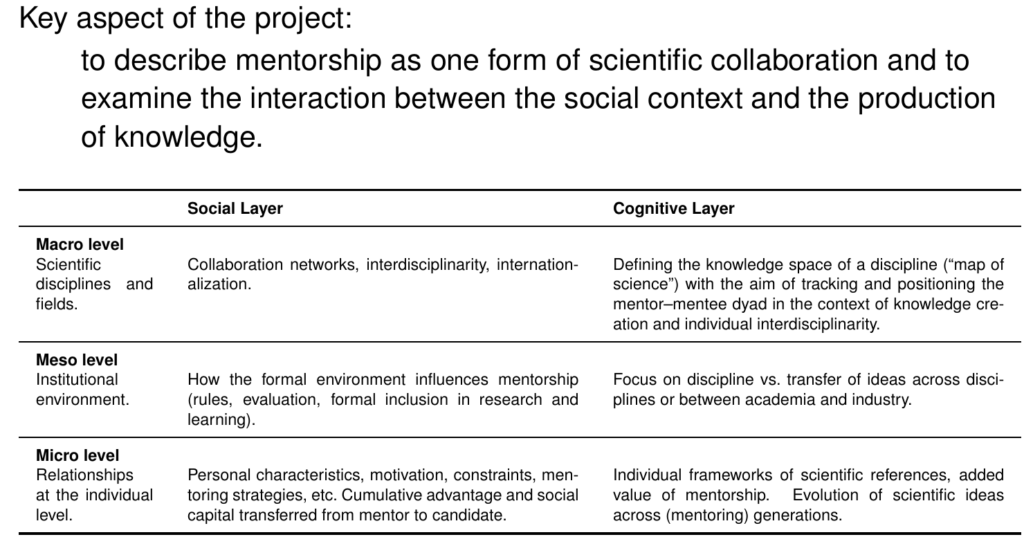
Work Structure
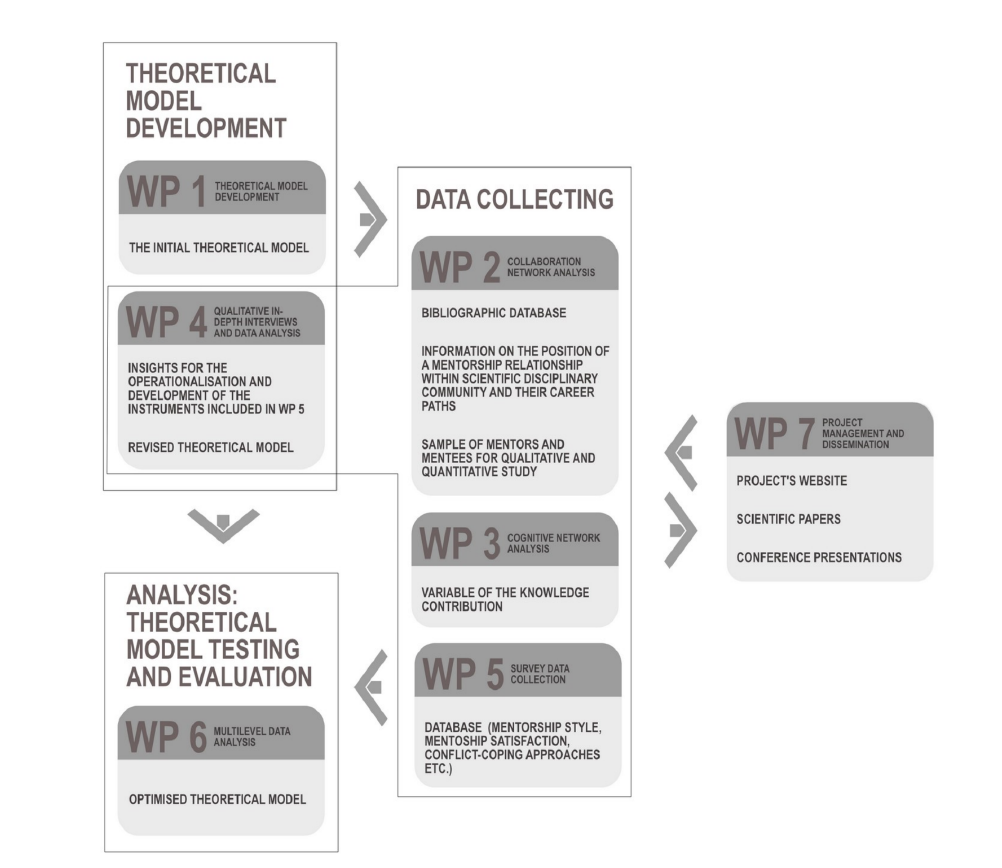
WP 4: Through the Eyes of Mentees and Mentors: Characteristics of the Mentoring Relationship and Their Connection to Knowledge Production in Science and Higher Education
Dr. Sara Atanasova
Results of a qualitative study conducted among mentees and mentors involved in mentoring relationships within third-cycle higher education (doctoral studies) in Slovenia. Particular emphasis was placed on identifying different types of mentees and mentoring styles, as well as their connection to various modes of knowledge production in science and higher education.
Published materials:
WP2: Mentorship and Co-Mentorship as a Means of Establishing Long-Term Scientific Collaboration?
Dr. Marjan Cugmas
The study examined whether the relationship between mentors and mentees is established shortly before the start of doctoral studies or whether it represents a continuation of an already existing collaboration. We were also interested in whether co-supervision can function as a mechanism for fostering long-term collaboration between co-supervisors.
Published materials:

WP3: Researchers and Knowledge Production
Dr. Luka Kronegger
Using stochastic methods for the analysis of network dynamics, we examined how researchers connect with different research topics and what role mentorship plays in this process.
Published materials:
WP5 (6): The Impact of Individual Factors on the Competencies and Satisfaction of Mentees
Dr. Marjan Cugmas
The results of the survey study indicate the influence of mentees’ personal characteristics (autonomy, relatedness, and competencies) on doctoral study outcomes (acquired competencies and attitudes toward publishing), as well as on various aspects of satisfaction with the study programme.
Published materials:
(WP 3): Approaches to Bibliometric Analysis Using Deep Learning
Đorđe Stevanović
Research information systems such as SICRIS continuously record publications, collaborations, and projects over long periods of time, thereby generating relational and time-stamped data that can be meaningfully represented as heterogeneous temporal graphs. This thesis develops a predictive model for forecasting the number of mentorships, where the SICRIS schema is mapped onto a heterogeneous graph and the model is evaluated using five-year forecasting horizons. The core components of the model include a heterogeneous graph transformer, residual layers, Jumping Knowledge aggregation, and stochastic graph regularization (including edge dropout and activation dropout). The model is compared with a strong tabular baseline model, XGBoost. The tasks are defined for individual researchers at different time points and include both binary outcomes (at least one doctoral or master’s mentorship) and numerical outcomes (the number of such mentorships) within a selected time window. Empirical results on the SICRIS graph indicate that the heterogeneous, temporally sensitive model outperforms the tabular baseline. The analysis suggests that typed attention with relative temporal encoding, together with Jumping Knowledge aggregation, more effectively models multi-hop and multi-relational data, while stochastic graph regularization helps stabilize deeper layers.
Published materials:
Globoko relacijsko učenje nad bibliografskimi podatki – diplomska naloga (thesis – slo)Prenos
WP7: Dissemination
Professional Conference on Mentoring Relationships and Knowledge Transfer
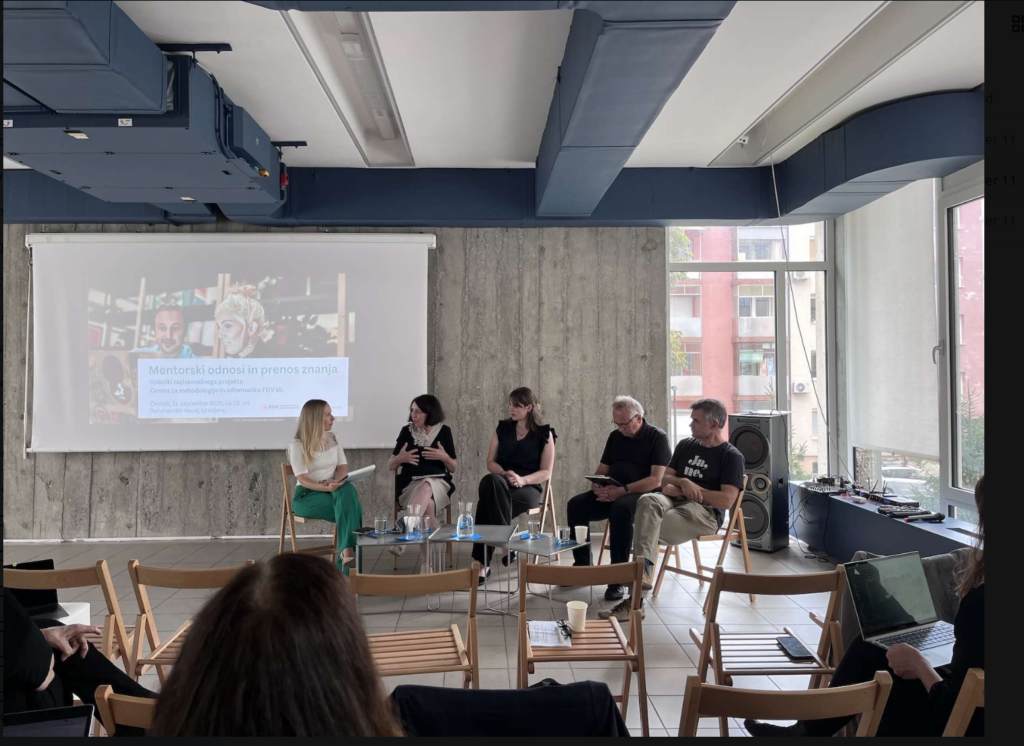
Round table 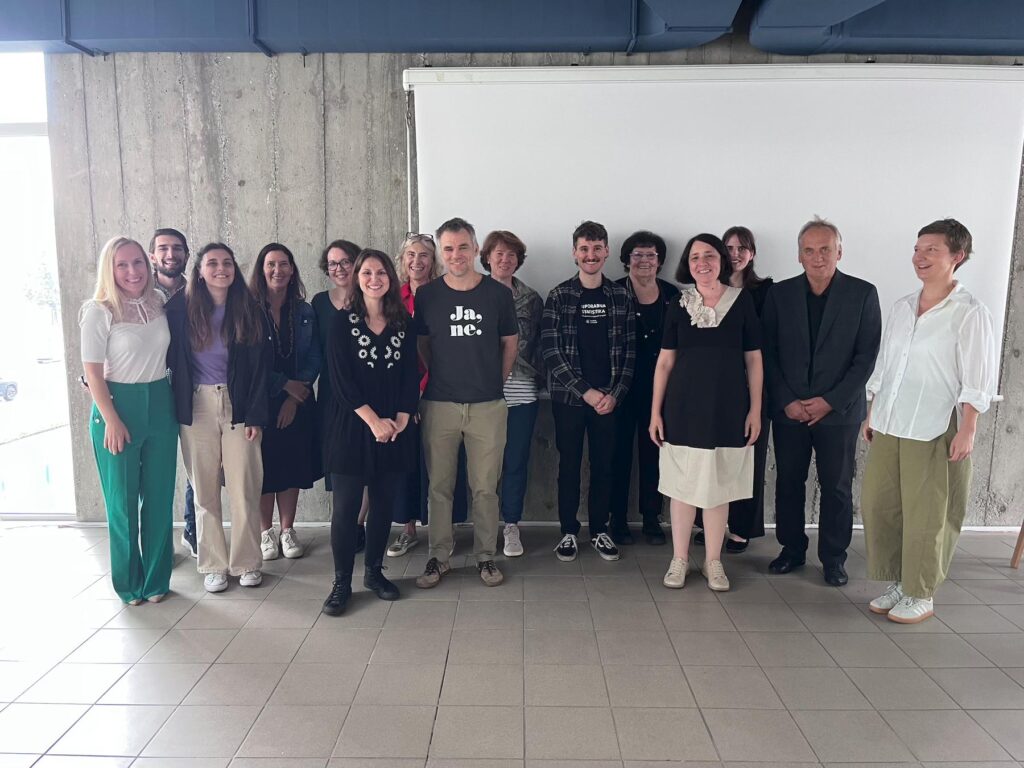
Participants
Round table discussion moderated by Maja Ratej, featuring Prof. Dr. Tatjana Marvin Derganc, Head of the University of Ljubljana Doctoral School; early-career researcher Neja Bizjak Štrus from the Young Academy; Prof. Dr. France Mali from the Centre for Science Studies at the Faculty of Social Sciences, University of Ljubljana; and Associate Professor Dr. Luka Kronegger, head of the project Mentorship in the Context of Scientific Collaboration and Knowledge Production.